AI Can Write a Proposal. It Can’t Win One.
After fifteen years and over 750 proposals, I can tell you with confidence: I’ve never seen a firm lose a bid simply because its writing wasn’t polished. I have seen plenty of firms lose because they had no real strategy, no genuine understanding of what the client cared about, and no process for turning their expertise into a compelling, differentiated submission. AI doesn’t fix any of that. In fact, it can make it worse.
Key Takeaways
- AI accelerates proposal production but cannot replace the strategic thinking behind a winning submission.
- Selection committees choose based on value, trust, and fit – not polished content alone.
- Firms using AI to substitute for capabilities they never built are at greater risk, not less.
- The competitive advantage in bid development is shifting decisively to strategy, systems, and judgment.
- Building internal proposal capability now is how professional services firms compound their win rate.
Winning Is a Thinking Problem, Not a Writing Problem
The firms that consistently win competitive bids don’t do so just because their proposals are better written. They win because someone made the right call on which pursuits to chase. Someone built a genuine understanding of what the client actually cares about – not just what the RFP says, but what’s keeping them up at night. Someone developed a response strategy before anyone opened a document.
AI can speed up the writing. It cannot do any of those things.
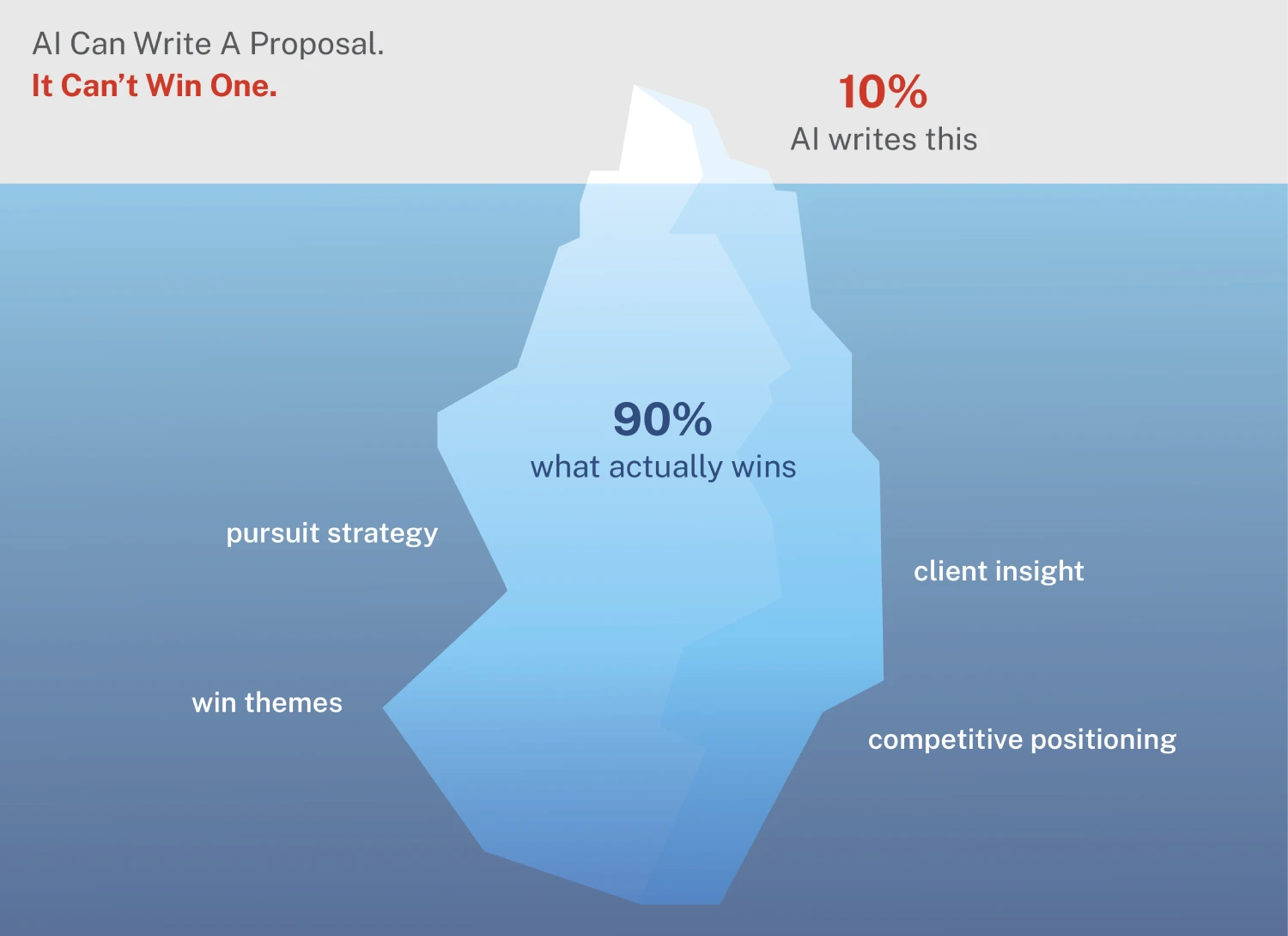
Think of a proposal like an iceberg. The polished document the client receives is 10 per cent above the waterline. The strategy, the relationship intelligence, the win themes, the competitive positioning – that’s the 90 per cent underneath. AI is getting very good at the 10 per cent. The 90 per cent is still all yours.
The Firms at Risk Aren’t the Ones Using AI
Here’s what I keep seeing, and it concerns me. The firms most exposed to the rise of AI aren’t the ones using it. They’re the ones using it to avoid the harder work they should have been doing all along.
There’s a version of AI adoption that creates real competitive advantage – using it to eliminate the routine so your team can spend more time on strategy, client insight, and differentiation. Faster first drafts. Automated formatting. Quicker compilation of past project experience. These are genuine productivity gains, and I’m all for them.
But there’s another version that creates risk: using AI to substitute for the capability that was never built in the first place. Firms that have always outsourced their proposal thinking – to outside writers, to whoever was available, to whoever hadn’t said no yet – are now outsourcing it to AI instead. The output looks more polished. The underlying problem hasn’t moved.
Selection committees are getting sharper at spotting this. When every submission in a competitive field reads like it was generated by the same tool, differentiation disappears. The firms that stand out are the ones with something specific to say – a genuine point of view, a credible methodology, a track record presented with precision rather than cut-and-pasted from a database. That kind of differentiation comes from capability, not tools.
What Evaluators Are Actually Looking For
Evaluators don’t score proposals solely on production quality. They’re making a judgment call on three things: whether this firm understands what we actually need, whether we trust them to deliver it, and whether we want to work with them. These aren’t criteria you can generate your way past.
This is the insight behind the Value-Trust-Like (VTL) Framework – the model we use at The Proposal Lab to understand how selection decisions are made. In our experience, the three filters of Value, Trust, and Like operate whether the evaluator is conscious of them or not.
I saw this play out recently with two firms competing for the same professional services contract. The first submitted a sharp-looking proposal – clean layout, tight writing, clearly well-resourced. The second had a rougher document, but it opened with a precise description of the client’s actual challenge – the kind of insight that only comes from someone who did their homework. It named a specific risk the client hadn’t publicized but was privately worried about. The evaluator’s reaction to that second proposal was immediate: these people get it. The first firm never had a chance after that.
That reaction – Value, Trust, and Like all firing at once – is what great proposals produce. And no amount of AI-assisted polish on the other submission changes the outcome. AI can generate language that sounds like it addresses all three factors. It cannot substitute for the firm that has done the work to earn them.
The Competitive Advantage Has Shifted — and It’s Yours to Capture
The floor on proposal quality is rising fast. AI is making it easier for every firm to produce a technically competent submission. That means competent is increasingly table stakes, not a differentiator.
The firms that will widen their win rate over the next five years share a few things in common. Their proposal teams have been trained, not just briefed, on how to develop a win strategy, structure a persuasive response, and execute under deadline pressure. They maintain a Proposal Content Library: a curated foundation of past project experience, capability statements, and vetted messaging that reflects the firm’s real expertise rather than whatever someone can pull together in forty-eight hours. They run structured review cycles that improve the submission rather than producing a round of conflicting last-minute edits. And they make deliberate pursuit decisions – chasing opportunities they can genuinely win rather than responding to every RFP that lands in the inbox.
These are not the habits of firms using AI as a shortcut. They’re the habits of firms that have invested in building a repeatable, scalable proposal capability. And that uses AI to make that capability faster and sharper, not to replace it.
The question isn’t whether your firm is using AI. It’s whether your firm can use it well. That capability doesn’t come with the tool. You have to build it. And the firms that start building it now will be compounding that advantage long after everyone else catches on.
Now is the right time to start.
About the Author