Why Your Firm Keeps Losing Bids (Hint: It’s Not the Writing)
Picture the debrief. You lost the bid, you ask why, and the client says something polite and vague about a strong field. So you drive home and tell yourself the same thing you told yourself last time: we need to write better proposals. I have sat through a lot of those conversations, and here is what I have learned. The writing is rarely why you lost.
If you want to win more RFPs, you have to stop obsessing over the words on the page and start looking at everything that happened before you wrote them.
None of this means writing does not matter. It does. But writing is the last mile of a long race, and most bids are lost long before anyone gets there.
KEY TAKEAWAYS
- Firms lose far more bids to weak strategy and process than to weak writing.
- AI has made competent writing effectively free, so writing quality can no longer be your edge.
- Most losses trace back to decisions made weeks before anyone opened a document.
- Capability compounds over time. A single well-written proposal does not.
- Before you fix anything, identify the exact stage at which your pursuits break down.
The Writing Was Fine. You Still Lost.
Here is something that surprises people. When we review a proposal that lost, the writing is usually fine. Grammatically clean, on brand, answers every question the RFP asked. In more than fifteen years of reviewing proposals, I can count on one hand the bids that were genuinely lost on prose alone.
The proposal was a symptom, not the disease. The real problem sat upstream, in decisions made long before anyone opened a blank page. A beautifully written answer to the wrong question loses every time. Polish cannot rescue a flawed strategy.
Here is a version I see constantly. A firm loses a pursuit it should have won, so next time it hires a better writer and buys a slick template. The proposals get prettier. The win rate does not move. A year later, that same firm has decided proposals just do not work for them, when the truth is they never fixed what was actually broken.
How to Win More RFPs When Everyone’s Writing Is Good Now
Two years ago, clean, competent writing could set you apart. Not anymore. Any competitor can now produce a polished, readable draft with an AI tool in an afternoon. When everyone can clear that bar, clearing it no longer matters.
So how do you win more RFPs when the writing is a level playing field? You compete on the things AI cannot manufacture: strategy, judgment, proof, relationships, and a process that pulls all of it together consistently. The firms I watch pull ahead right now are not the ones with the cleverest prompts. They are the ones who accepted that good writing is table stakes and moved their energy upstream.
Moving upstream is not abstract. It means deciding which pursuits to chase before the clock starts. It means setting a win strategy on the first day, not the last. It means keeping a library of proofs you can reuse and running a real review before the deadline, instead of a spell-check at 11 PM. None of that is writing. All of it decides whether the writing ever had a chance.
The Real Reasons Firms Lose
Losses are not random. In my experience, they cluster in a handful of predictable places, and none of them is grammar.
- You pursued the wrong work. There was no disciplined bid or no-bid call, so you spread your team thin across bids you would never win.
- You started too late. Strategy got compressed into the final 48 hours, so there was no strategy, only a scramble.
- You answered the RFP instead of the problem. The document scored as compliant and read as forgettable.
- Nobody reviewed it with real distance. The people closest to the work cannot see its blind spots.
- You rebuilt everything from scratch. With no reusable, vetted content, every deadline is a fire drill.
The most common pattern I see is a team that starts three days late, then spends those three days writing instead of deciding. A fast, honest bid-or-no-bid call, which we run with a tool we call the 15-Minute Triage, would have ruled out half of those long-shot bids before anyone wrote a word. Saying no to the wrong pursuits is what frees a team to win the right ones.
I worked with a team that was proud of its 60-hour proposal marathons. Everyone stayed late, everyone cared, and they kept losing. When we mapped their process, the writing was never the issue. They started every bid 4 days before it was due, leaving no time to think. We moved the same effort earlier and gave them a faster way to decide. The marathons shrank, and the wins grew.
Capability Compounds. Writing Doesn’t.
A great proposal wins one bid. A capable team wins bids for years. That difference changes everything. Process, judgment, reusable content, and honest review all compound, because every pursuit makes the next one faster and sharper.
Capability is an asset that compounds. A single polished proposal is a one-time expense that returns nothing once the bid is over. Firms that invest in capability now are building something that pays out on every future pursuit. The ones still treating each bid as a stand-alone writing sprint keep starting from zero. This is the whole reason we stopped thinking of ourselves as a writing shop and started building capability instead.
The math is quietly brutal for firms that ignore this. If a competitor gets a little faster and a little sharper on every pursuit, and you start from scratch each time, the gap does not hold steady. It widens with every RFP you both chase. Compounding works for whoever starts first.
Start by Finding the Gap, Not Fixing It
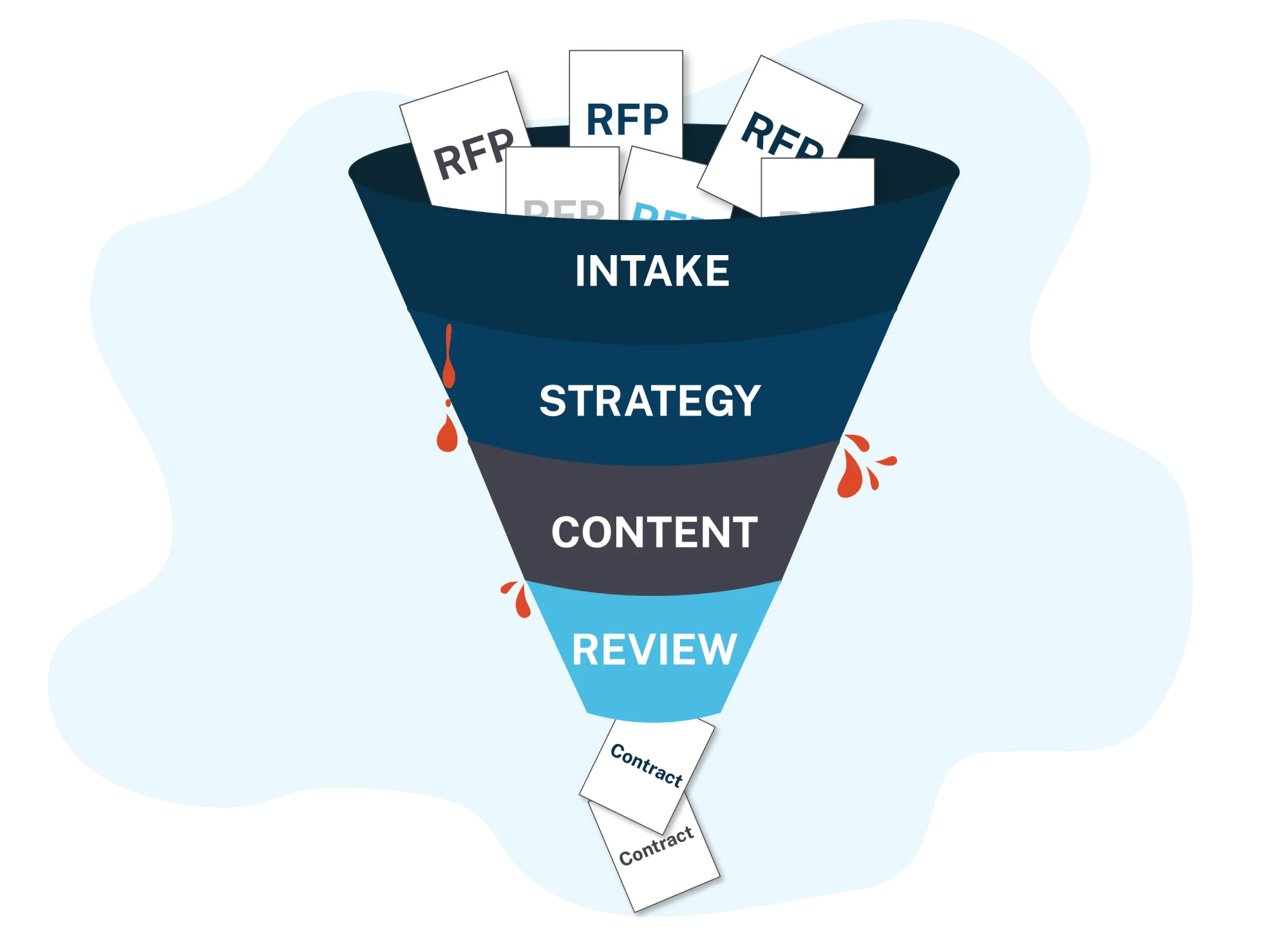
You cannot fix a capability gap you have not located. Most firms guess, and they guess writing, because the document is the only part they can see. Before you spend on training, tools, or new hires, get an honest read on where your pursuits actually break down: intake, strategy, content, review, or management.
You can do this informally tonight. Pull your last ten losses and, at each stage of the pursuit, ask what actually happened. Or you can benchmark your process against a structured capability framework and get a clearer, faster picture of the one or two stages that are quietly costing you wins.
Whichever way you do it, resist the urge to fix the loudest symptom first. Fix the stage that quietly costs you the most, even when it is the boring one. A firm that tightens its intake discipline usually wins more than a firm that doubles its writing budget.
This is unglamorous work. It is not a new template or a punchier opening line. It is the plumbing of how your firm decides, prepares, and reviews. But it is the only work that changes your win rate for good.
Your next lost bid probably will not be lost on the page. It will be lost in the decisions nobody made, the strategy nobody set, and the review nobody ran. Fix that, and the writing takes care of itself. That is how you win more RFPs: not by writing more, but by building the capability to compete on purpose.
About the Author