The Value-Trust-Like Framework: The Three Reasons Clients Choose You
I have watched the better-qualified firm lose more times than I can count. Better track record, sharper solution, lower risk on paper. And they still lost to a competitor the client simply liked more. If that sounds unfair, it is not. It is how human beings decide.
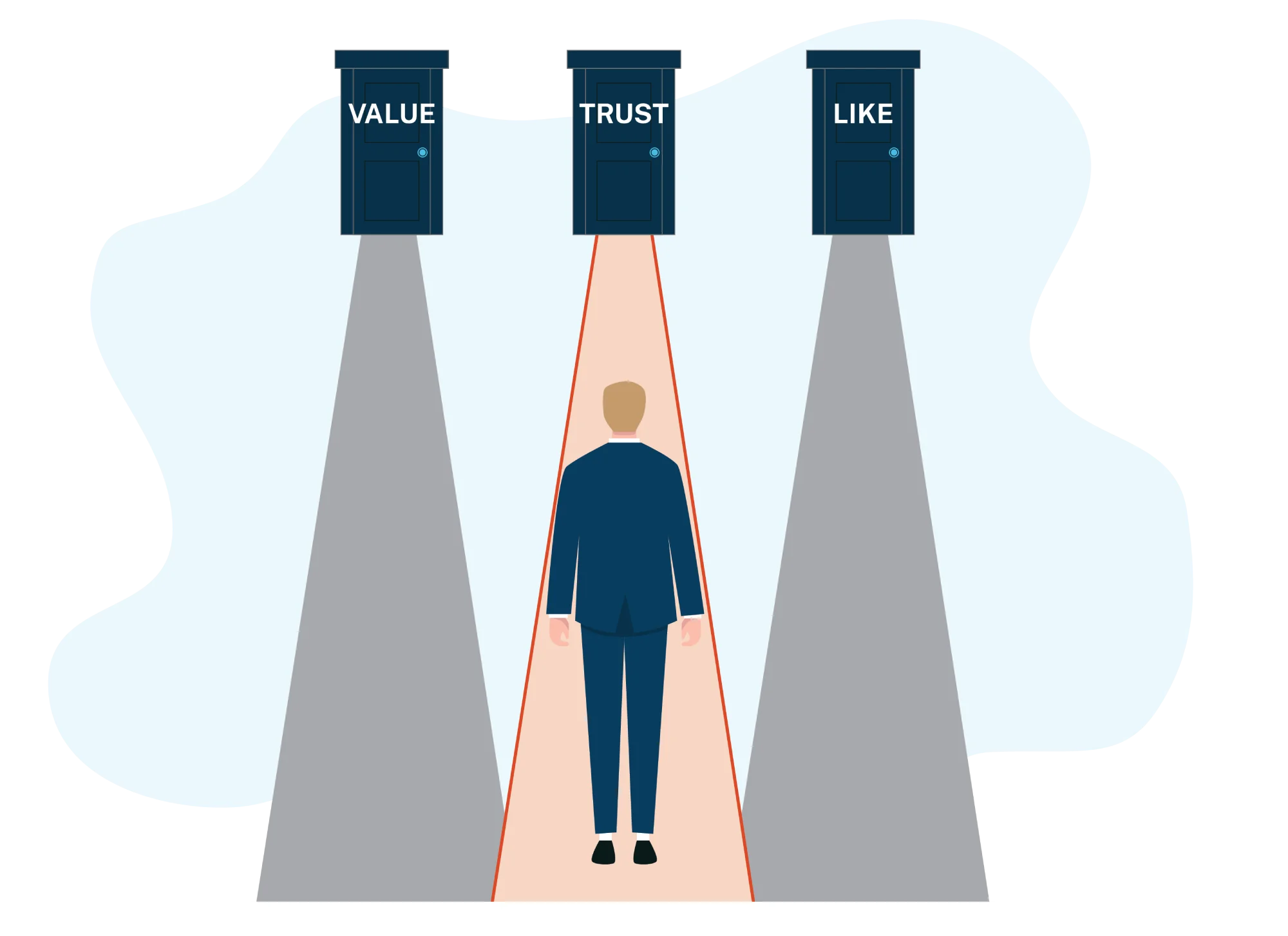
Every effective proposal persuasion strategy starts from one uncomfortable fact. The best proposal on paper does not always win. Clients choose the firm they believe offers the most value, trust to deliver, and want to work with. We call those three forces Value, Trust, and Like.
Understand those three, and you stop guessing why you win and lose. You start engineering it.
KEY TAKEAWAYS
- Selection is a human decision, not a scoring formula.
- Clients choose on three things: Value, Trust, and Like, usually in that order.
- Most firms over-invest in Value and neglect the other two entirely.
- Trust is earned with proof, not promises. Like is earned by making the client’s life easier.
- A persuasion strategy has to win all three deliberately, not by accident.
Clients Don’t Just Buy the Best Proposal. They Buy the Best Decision.
The person evaluating your proposal is not filling in a spreadsheet. They are human beings weighing risk and reputation, not just tallying points.
They have to recommend a firm to their colleagues and then own that decision. If the firm they backed underperforms, they are the one who looks wrong. So the real question behind every proposal is this: will choosing you make this person look smart, or leave them exposed?
This is why the better-qualified firm can still lose. Qualifications answer only one of the three questions. The firm that also feels safe to hire and easy to work with is answering all three, and that is a stronger bid.
After more than a thousand proposals, we found that, yes, it almost always comes down to those three questions. We built them into a framework we call VTL: Value, Trust, and Like. Get all three right, and the decision tips in your favour. Miss one, and even a technically superior bid can lose. Here is what each one really asks.
Value: Are You Solving the Problem They Actually Have?
Value is not your list of services or your years in business. It is the outcome the client actually cares about. Most firms answer the RFP as written, but the RFP is only a stand-in for the problem they are really trying to solve. Name that real problem, then show the outcome, and you win Value.
Think of the RFP as the menu and the client as someone who is genuinely hungry for one specific meal. The firm that describes the meal, not the ingredients list, is the one that gets remembered.
An example. Two firms bid on the same facility upgrade. The first lists its engineering credentials and past projects in careful detail. The second opens by naming the client’s real worry, keeping the building running during construction, and shows exactly how it will do that. The credentials underneath were nearly identical. Only one of them talked about the client’s actual problem. It is not hard to guess which one advanced.
Trust: Have You Proven You Can Deliver Without Surprises?
Value gets you shortlisted. Trust gets you chosen. Trust is the risk question, and it is answered with proof, not adjectives. Specific relevant projects, named results, and an honest treatment of what could go wrong will always beat “we are experienced and reliable.” Show it. Do not claim it.
Here is a counterintuitive move I have watched work again and again. The firms that win the most trust are willing to talk about what went wrong on a past project and exactly how they handled it. Nobody believes the firm that has never hit a problem. Everybody believes the firm that has handled one well.
Trust also lives in specificity. “We deliver on time” is a slogan. “We delivered a comparable project three weeks early after a permitting delay, and here is how” is evidence. One asks to be believed. The other makes belief easy. In a stack of proposals that all promise reliability, the specific one is the only one that earns it.
Like: Do They Actually Want You in the Room?
This is the pillar most firms dismiss, and it is often the deciding one. People give important work to people they want to spend the next eighteen months with. Like is not charm or flattery. It is how easy you make the client’s life.
A proposal that is clear, responsive to their language, and respectful of their time signals a partner who will be the same. A proposal that is a chore to read signals a partner who will be a chore to work with. Every evaluator has felt both, and they remember the difference.
Small things carry enormous weight here. Answering the question they actually asked. Using their words, not your internal jargon and making the document easy to skim for the person who has ten more to read after yours. These feel like formatting choices. To the reader, they feel like respect, and respect is the quiet foundation of Like.
I have seen a client choose the second-ranked firm on price and capability for exactly this reason. The top-ranked bid was dense and self-satisfied. The one they picked read as if the firm had actually listened. When two strong firms are close, Like breaks the tie almost every time.
Building a Proposal Persuasion Strategy That Earns All Three
The order matters. Value, then Trust, then Like. But most firms pour ninety percent of their effort into Value and run out of energy long before they get to Trust and Like. That is why so many technically strong proposals still feel flat and forgettable.
Watch what happens when a firm nails one pillar and skips the rest. A brilliant technical solution with no supporting evidence reads as risky. A capable, trustworthy firm whose proposal is a slog to get through never earns the goodwill that breaks a tie. The bid does not fail loudly. It quietly comes second, again and again, and the firm never quite works out why.
A real proposal persuasion strategy allocates deliberately across all three. It is not about writing stronger sentences. It is about making sure every section is doing one of the three jobs, on purpose. Learning to apply that lens section by section is exactly what a structured proposal training curriculum is built to teach a team.
You can start tonight. Take your last proposal, go section by section, and mark whether each part is building Value, Trust, or Like. The sections doing none of the three are the first ones to cut.
Do that exercise honestly, and it stings a little. Most firms find whole pages that build nothing, and one or two pillars they have been neglecting for years. That discovery is the point. You cannot balance a persuasion strategy you have never actually looked at.
The best-written proposal in the pile does not always win. The one that makes a nervous human being feel confident, safe, and glad to say your name in the boardroom does. Build for Value, Trust, and Like, in that order, and you stop hoping to be chosen. You give them every reason to choose you.
About the Author